
What happens when we start chasing health the way we once chased success?
Somewhere along the way, being healthy became a flex.
Years ago, if a 55-year-old guy walked into an upscale restaurant wearing a Rolex, some jewelry, a nice suit and pair of shoes, and then drove away in a luxury car, we pretty much filled in the rest ourselves. He reflected the kind of success we’d been taught to chase. At least, that’s what we assumed. Never mind that he might have been out of shape enough to need a minute to catch his breath after the walk from the restaurant to the valet to get his Mercedes. We didn’t pay nearly as much attention to that part. The clothes mattered, the watch mattered, the jewelry mattered, the car mattered, and it didn’t just stop there either. The house, the title, the income, all of those were the things we associated with having made it.
Today, I’m not so sure.
There’s something different now about that same 55-year-old guy, walking into the room looking strong, lean and clearly capable. He could be wearing something as plain as a t-shirt, jeans, and sneakers, and it wouldn’t matter. He fit the clothes, not the other way around. We notice him because being in that kind of shape has become the exception, not the rule. Maybe he’s just got an Apple Watch, an Oura Ring, or some other health tracker on his wrist, but it almost doesn’t matter, because somewhere along the way our perception of wealth started changing.
I can relate to that because something similar happened to me not too long ago. About a year into a high-accountability coaching program I’d committed to, not just a generic gym membership, my wife and I went to a pool party at the home of one of her friends over Memorial Day weekend this year. Many of them hadn’t seen me in shorts and a t-shirt since the Fourth of July pool party at that same house last year and had all kinds of things to say. Some mentioned the weight I’d lost, others how much stronger I looked, a couple said I looked great overall. A few even mentioned I looked younger, though I suspect shaving off my gray beard had a lot to do with that one. But almost everyone asked the same thing after their initial comment, what did you do, or what are you doing? Nobody was clocking my outfit, my jewelry, or the car I arrived in. They were paying attention to me. What’s ironic is if I’d shown up wearing a flashy new watch or pulled up in an expensive new car, nobody would have asked what I did to get them. To be honest, those questions, what had I done or what was I doing, gave me more satisfaction than any compliment about some outward marker of success ever could.
That was the physical part, and I’m grateful for it. But a flex like that only lasts as long as you can hold onto the body behind it, and that’s what I kept circling back to. Not what shape I was in or how I looked, but how long that strength would actually last.
Watching the last quarter of my grandfather’s life is a lot of why that question mattered to me. I was so accustomed to seeing him a certain way, energetic, always doing things on his own without needing help, that watching him go through those last years felt like a glimpse into what my future could be if I didn’t address some of my own issues. He took care of his body the best way he knew how, but there was plenty he never had the tools or information to do differently. Even so, his mind stayed sharp all the way to the end. He died at 94, just three months shy of his 95th birthday, still mentally there, still himself. But his body gave out long before his mind did, and that decline didn’t happen in some sudden last chapter, it built for decades.
I look a lot like him physically, but in plenty of other ways too. How I react to things, how I carry myself, even some of the ways I’ve lived my life. I saw myself in him, a sharp mind trapped in a body that quit too early, and I started wondering what those years might have looked like if he’d had access to what we know now about staying ahead of the decline instead of just reacting to it. Then I started noticing the same pattern in my mother too, closer to home. It wasn’t just him anymore. It was three generations of the same road, and I was next in line.
That’s the part that actually changed things for me, not only in the numbers on a page, but seeing it in the people I come from. Looking back, my grandfather’s end was always going to eventually arrive. So what I keep thinking about isn’t that. It’s everything that led up to it, the decades where a different path could have made a big difference.
It’s what got me wondering whether this was actually just genetics, something fixed and out of my hands, or whether the pattern could somehow be changed. I didn’t like the idea of just accepting it because it ran in the family, so I started looking into whether anything could be done differently.
We were similar enough that I wondered if his lifespan might be one more thing we’d end up sharing. I’m not assuming that just because he lived into his nineties, I automatically will too. But if that turned out to be true for me as well, I wanted to be proactive about it, to forge a different path for those years leading up to whatever decline eventually comes, so they’d actually be lived well instead of just lived through. That was one of the main reasons I joined the fitness program in the first place, and it’s the same thing that kept me looking for more once I was already in it. If you’re looking at your own family and seeing that same pattern, genetics that seem to be steering you toward the same decline, this is for you too. Maybe you can’t control everything genetics handed you, but you don’t necessarily have to accept the same trajectory either. And in choosing a different path for yourself, you may also be showing others in your family, including your kids, that they can do the same. You may even end up influencing friends and other people around you simply by letting them see what’s possible.
Lately, I seem to hear the expression “health is the new wealth” more than ever. It’s become one of those phrases that gets repeated so often that it’s easy to dismiss it as another cliché. But recently I’ve been wondering if there’s more truth in it than I originally thought, and not just in the way people usually mean it.
Everyone talks about the physical transformation, the weight, the strength, the way clothes fit differently. I experienced all of that, but what surprised me most was the mental shift that came right alongside it. I became more confident. I carried myself differently. I felt differently about myself, and started feeling capable of things I might not have felt capable of before. That part crept up on me, and if I’m being honest, it may have ended up mattering more to me than the physical changes themselves.
I think about all the years I spent planning and waiting for the perfect time to start exercising, as if everything had to fall into place before I could actually start. I had convinced myself I was being patient, but in reality I was simply avoiding the discomfort that comes with just starting. Waiting had become its own kind of safety, and I didn’t even notice I was actively choosing it. But here’s the irony about that thought process. I was building a life I would in theory be able to someday enjoy, but the way I was building it made it less and less likely I’d have the health to actually enjoy it.
That’s a hell of a trade.
I told myself some version of the same thing for years. I’ll get in shape later. I’ll eat better once things settle down. I’ll sleep more when work isn’t so crazy. The problem was, things never really settled down. There was always something else that needed my attention, and later just kept becoming next week, next month, next year.
While I was busy chasing the version of success I’d come to believe mattered, influenced by years of being shown what success was supposed to look like, I was quietly borrowing against my own health to pay for it. My body was keeping score too, even when I wasn’t looking.
That’s the piece I wasn’t paying attention to, and it’s probably the biggest change in how I look at success today. I spent the first half of my life building the life I imagined I wanted, and since health and fitness never made it onto that list, unknowingly I was on track to spend the second half too depleted to actually enjoy what I’d worked so hard to build.
That realization is what eventually led me to Cenegenics.
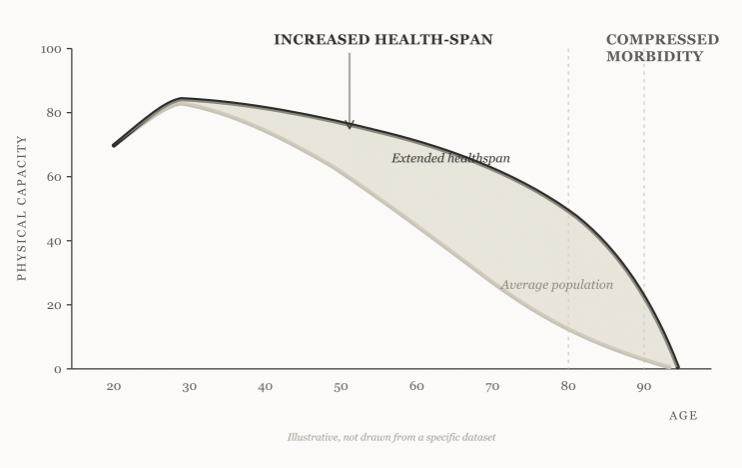
Realistically, I’m not trying to live forever, and I’m not even sure I’d want to. What I do want is to stay capable and confident for as long as I reasonably can, so that when the work finally slows down, I’m actually able to enjoy it instead of just having earned it. That’s the version of the future I’m actually chasing, and I came across a chart that put the idea into a picture better than I could put it into words. Two people can ultimately arrive at the same destination, but the years leading there can look very different. One curve shows physical capacity declining steadily over decades. The other tries to hold that capacity higher for longer, pushing most of the decline toward the end. It’s illustrative, not a prediction and certainly not a guarantee. But I recognized that first curve immediately. That’s the curve I watched my grandfather live, and it’s the one I’m interested in changing. I’m not investing in avoiding the end. I’m investing in everything I might still be capable of doing before I get there.
Once I decided I wanted to take this more seriously, there was something else I needed to figure out, where do I go to get the kind of help I was looking for? What I found was that there was no shortage of choices. Longevity has become an industry, and everybody seemed to have a different answer and a different approach. So I started the way I usually research most things these days, a Google search, followed by AI-assisted comparisons, and a lot of digging. I finally narrowed it down to a few programs, and Cenegenics kept coming back to the top of my list for one reason that really stood out to me, they had been doing this for a long time. They’ve been doing this since 1997, which is a long time in a space full of newer competitors with thin reviews and no real track record behind them. They’ve also grown into a real network of centers, with locations spread across the US and into other countries across multiple continents, which told me this wasn’t some longevity startup that showed up last year. I didn’t want to commit to something only to find out two years down the road that they were going out of business.
What also attracted me was their concierge model. I liked the idea that when it was time for bloodwork, a phlebotomist could come to my house instead of me having to find the nearest Labcorp and sit around waiting to get my blood drawn. That’s how it works for me now. Each quarter, they send someone to my house for the blood draw. But I also wanted the option of an actual physical location I could get to for consultations and scans, not just video chat calls. Their New York location was the closest to me, still a drivable trip or train ride away rather than somewhere I’d have to get on a plane to reach. And since the first assessment required an in-person visit, that proximity was important to me.
That first appointment wasn’t your typical 20-minute doctor visit either. The full assessment ran close to four hours and consisted of a physician consultation to review the lab work, a carotid artery ultrasound, a DEXA scan, a VO₂ max test, a strength and flexibility assessment, even a postural evaluation. My bloodwork was drawn ahead of time so the results would be ready to review in person. By the end of it, the Cenegenics physician wasn’t just handing me a printout. She was building a plan around nutrition, supplementation, and follow-up labs to see if any of it was working. There was also an ongoing fitness approach available to me, though at that point I was still with my previous program and hadn’t tapped into that side of things yet.
What stood out most, though, wasn’t any single piece of the plan. It was the difference in what each model was actually looking for. In my experience, my traditional care was largely focused on whether something had crossed the line into a problem. If it hadn’t, or even if something was borderline, the conversation was usually some version of eat better, exercise more, and we’ll check it again next year.
Cenegenics was looking at it differently. They weren’t only looking at where my numbers were now. They were also looking back at where they’d been and what those earlier numbers might mean, even if they’d since returned to normal. If something had been elevated or moving in the wrong direction in the past, they wanted to know whether it was worth taking a closer look to see if anything had developed during that time. My history of fatty liver, along with years of elevated liver enzymes, led her to take a closer look at my liver. An older calcium score that was considered normal to low for my age still showed some plaque, which was enough for her to want a closer look at what kind of plaque was there. Even a past instance of blood in my urine that had since resolved was still important enough for her to recommend I see a urologist to investigate what might have caused it.
She also recommended 3X4 Nutrigenomics testing, and built a supplement and vitamin plan based on my actual bloodwork rather than generic dosing. Although Cenegenics sells its own supplements, and they were offered to me, I was also given the option to source them elsewhere as long as the quality matched. I appreciated that, and at no point did I feel pressured to buy their supplements simply because their name was on the bottle. Even so, there’s something to be said for not having to go hunting for the right brand or formulation myself. Having everything already lined up and ready to order made it that much easier to actually stay consistent with the plan.
The membership I chose also includes quarterly testing, which gives us four opportunities a year to see what’s changing and adjust along the way, rather than waiting for the annual bloodwork I was accustomed to with my regular physician. Although the DEXA scans and VO₂ max testing are technically unlimited, Christian, my Performance Health Coach, recommended, at a minimum, running them on the same quarterly schedule as the bloodwork so everything gets reviewed together instead of on its own separate timeline. My testosterone therapy, which I’d started around the same time I began my fitness program, was also seamlessly folded into their care.
There’s one more piece worth mentioning. For my monthly investment, the membership I chose includes quarterly bloodwork and unlimited access to the doctor and fitness coach at my location. When I spoke with Christian about what that coaching actually looks like, he described weekly check-ins on macros, workouts, sleep, step count, and weight, which sounded almost identical to the structure I’d already gotten used to at my last program, so the idea of eventually using it felt less like starting over and more like picking up where I’d left off.
The Cenegenics Coach app itself was actually the same platform I’d already been using with my last program, so nothing about that part felt new. Christian can build and assign workouts right in the app, while things like macros, steps, weight, and other markers can populate automatically once it’s connected to the trackers I’m already using, including my smart scale, Apple Health, and Oura Ring. Even progress photos can be uploaded directly instead of being texted back and forth.
What was new to me was the Cenegenics app itself. That’s where my bloodwork, testing history, biomarker reports, and full regimen, including nutraceuticals, hormonal therapies, and prescriptions, are all kept in one place, along with a direct way to contact my Cenegenics physician when I need to. Brianna, my Member Experience contact, is who I go to for pretty much everything else, questions, scheduling, whatever needs sorting out. I like the convenience of not having to hunt through different apps, portals, or paperwork to find something. It’s all right there. DEXA and VO₂ max testing were also new to me, since my last program never included them.
I haven’t started the coaching side of it yet. I only left my previous program a couple of months ago, and part of the reason for leaving was proving to myself that I could keep this going without someone checking in on me every week. But the coaching offers more than accountability. If I decide I want to add muscle, develop a particular area of my body, or simply build a more balanced physique, the fitness coach can structure my workouts around those specific goals and adjust them as I progress. So even if I never need someone checking up on me every week again, there’s still value in having that expertise available. And if I do want that layer of accountability again, that’s already there too, all as part of the membership I’m already paying for.
Sixteen months ago, the fitness program I joined is what got all of this started. It wasn’t just workouts, it was real structure and real accountability. Eleven months ago, Cenegenics entered the picture, so I’m not giving it full credit for a transformation that had already started, but they’ve been a crucial part of it since and an important part of how I’m approaching what comes next.
My path ended up running through two separate companies, one that got the physical transformation moving and another that’s helping me maintain what I built and figure out where to go from here. What I didn’t realize going in was that Cenegenics actually had the structure to do both. I came to them for one part of the equation and have since realized they can give me both under one roof.
Here’s what this whole process has actually meant, in numbers instead of just feelings. When I started with my original fitness program sixteen months ago, I was coming from a high of 191 pounds at 5’6″, sitting around 31.5% body fat and struggling to hit 3,000–4,000 steps in a day. Over those sixteen months, with Cenegenics becoming part of the picture eleven months ago, my average has climbed to more than seventeen thousand steps a day, my weight has settled in the mid 150s, and I’m sitting around twelve to thirteen percent body fat.
The outside of it was only half the picture, though. At their worst, several of my key markers, liver enzymes, cholesterol, triglycerides, and blood pressure, were all moving in the wrong direction. My doctor hadn’t called any of it a diagnosis yet, but the warning signs were clear enough that I couldn’t just shrug them off.
Today, those same markers have moved back into healthy ranges. None of that happened by accident, and none of it happened because I waited for an annual physical to tell me whether I was still “in range.” It happened because I started paying attention, changing what I was doing, measuring the results, and adjusting along the way.
Eleven months doesn’t tell me I’ve reversed aging, and one biological-age calculation certainly isn’t a crystal ball. But moving from three years older than my chronological age to more than five years younger got my attention. What made it feel significant wasn’t the number by itself. It was that it was moving in the same direction as everything else I could actually see and measure: my weight, body fat, activity level, liver enzymes, cholesterol, and triglycerides. I wasn’t just feeling better. The numbers were telling me the same thing.
None of the success I’ve achieved in any of this has come free. That’s something I want to be upfront about. Nothing about this was magic. Not money, not joining a program, not some promise that someone was going to do the work for me. It took real effort, and it still does.
Cenegenics gives me the infrastructure to support that effort: the testing, the data, the medical oversight, the coaching. But what I do with all of that is still up to me. No amount of money changes that. I still have to exercise. I still have to pay attention to what I eat. I still have to make the right choices when nobody is watching. The program can give me better information and better tools to work with, but I’m still the one who has to use them.
There’s a financial cost too. There’s an initial fee for what they call the PHA, the Performance Health Assessment, followed by an ongoing monthly investment depending on the membership level you choose. I’m not going to pretend otherwise. But I’ve started looking at cost differently too, because at some point we all pay one way or another.
We can pay now, in money, time and effort, to build strength, preserve what we have and pay attention to problems while there’s still something we can do about them. Or we may pay later through preventable health problems, more medical care, fatigue and regret. Both are hard in their own way. One builds you. The other can break you down slowly enough that you almost don’t notice until it’s already happened.
I know which one I’d rather choose. It’s the same choice I wish I’d made decades ago, back when I was building a life I assumed I’d eventually get around to enjoying.
I used to think building a good life was the finish line. The house, the business, the things I could point to and say, I did that. I’m not walking any of that back. I’m still proud of it.
But somewhere along the way I stopped asking what I was building and started asking what I’d actually get to do with it. Those turned out to be two different questions, and for years I was only answering one of them.
So this is what I’m actually investing in now. Not just more time, but the ability to use it. And not just the body people noticed at that pool party, either. What mattered more was what came with it: the confidence, no longer hiding, no longer ashamed of how I looked or felt in my own skin. That confidence has me doing things I never would have chosen to do before, and it’s changed how I show up for the people around me too.
But underneath all of it is the same goal: to still be capable, still be present, and still be around long enough that all the years of building actually mean something.
That’s the return I’m after. Everything else was just the down payment.
What I’m Actually Investing In
A Reflection by Alexander Bush
© 2026 | krysalisforge.com

Leave a Comment